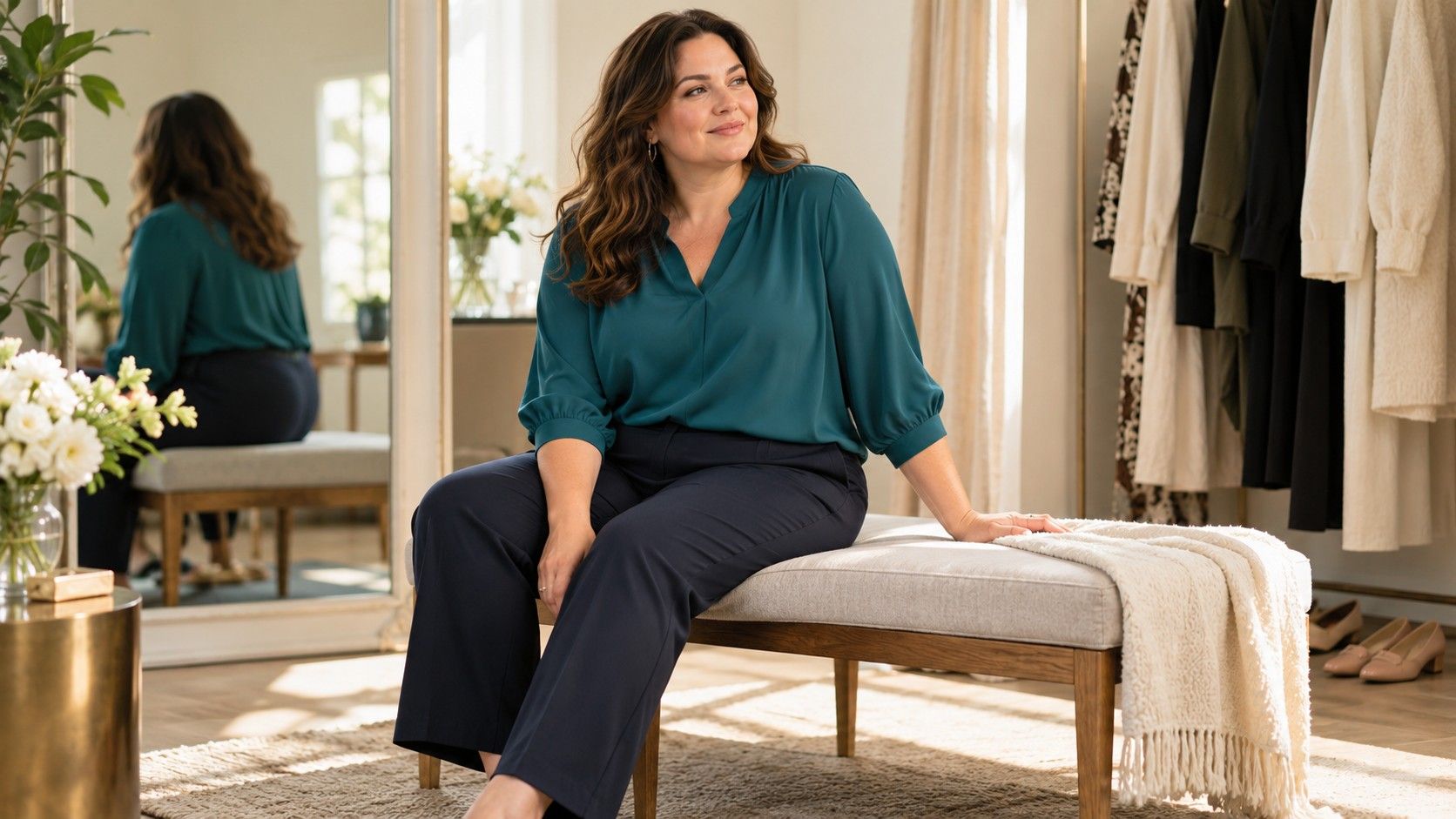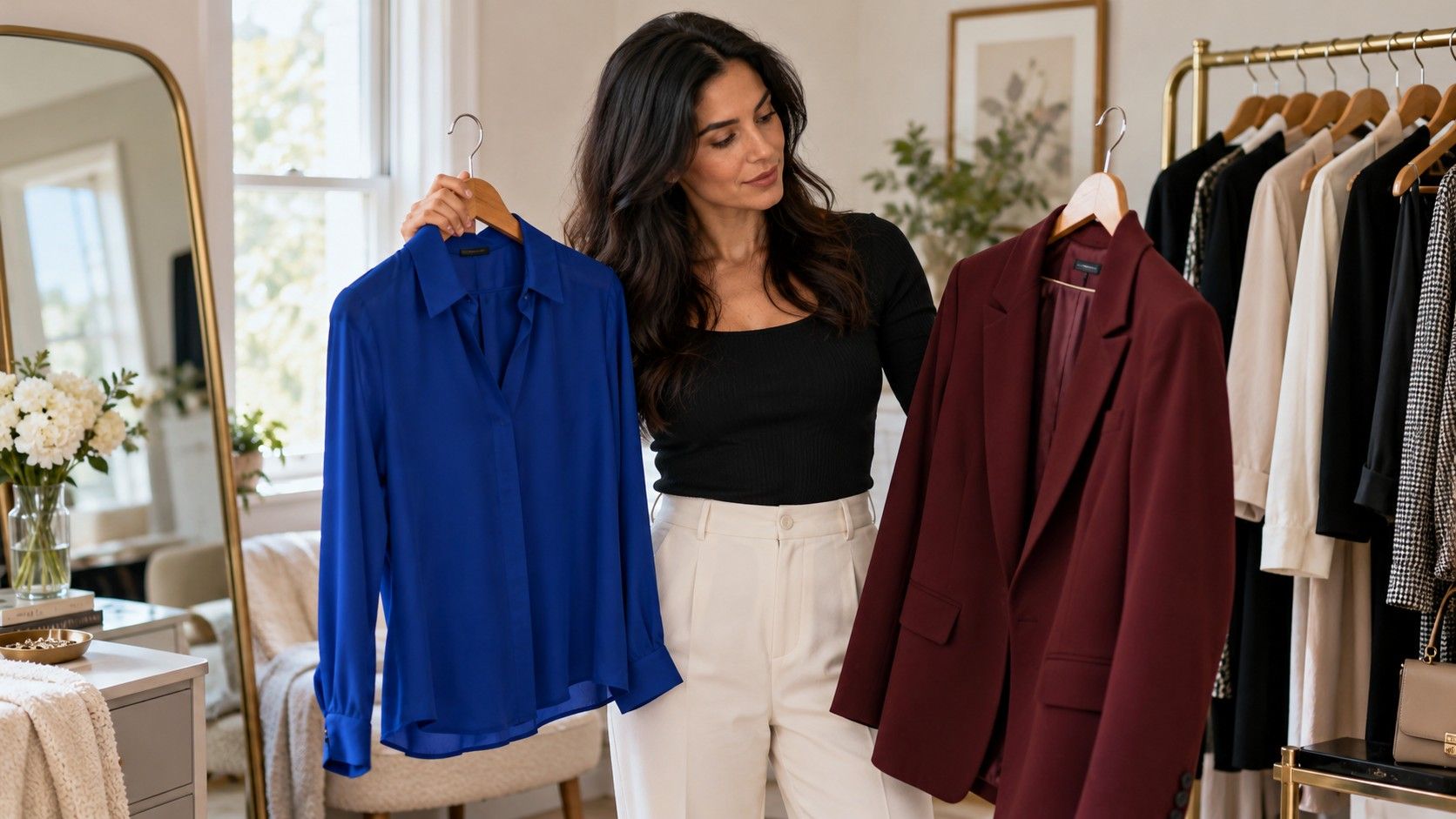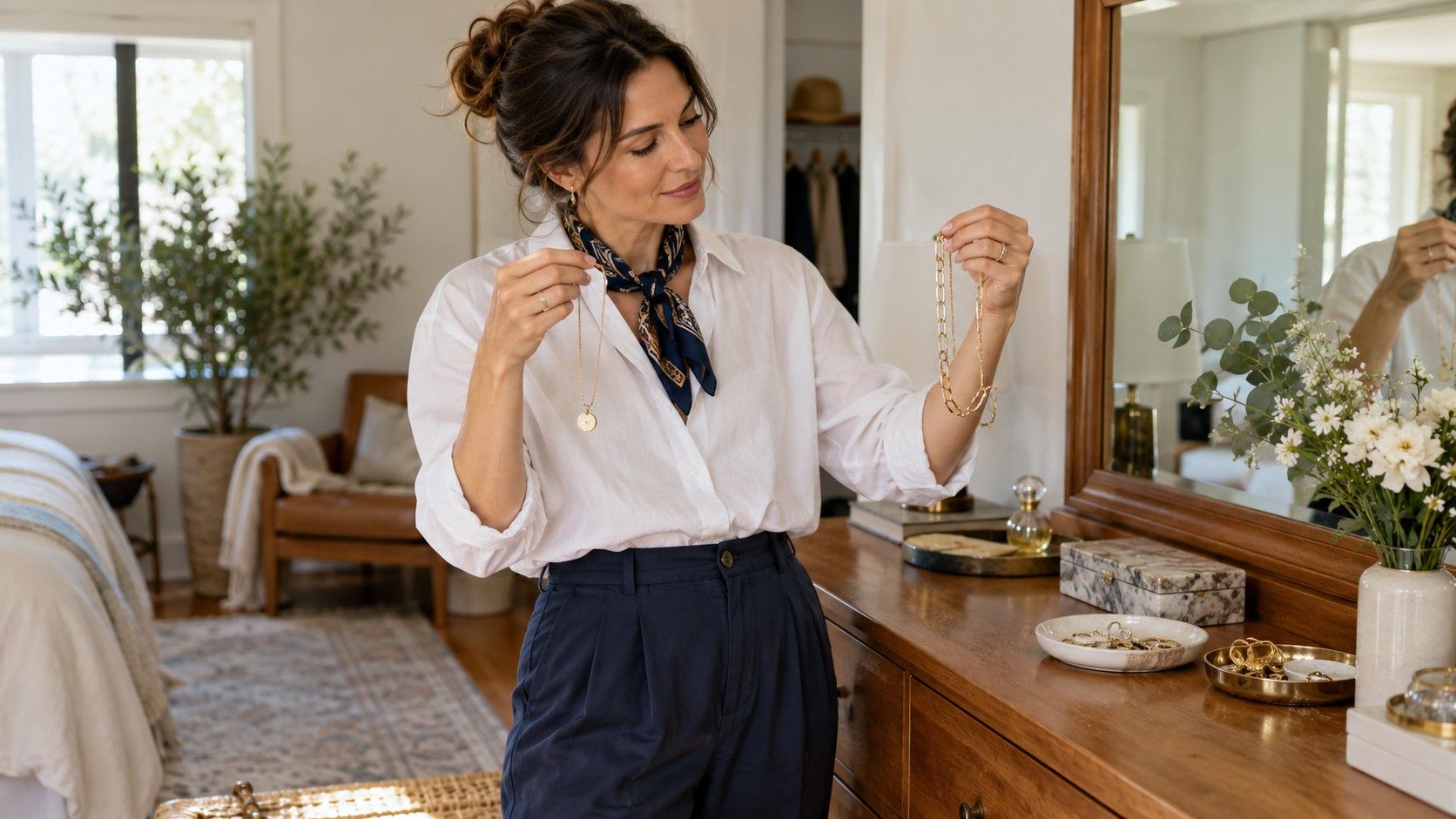
A style essence blend sounds abstract until you are standing beside a wardrobe wondering whether to add a scarf. That small decision is a better place to begin than a percentage chart. You can compare visual details using clothes you already own, keep the combinations you enjoy and leave the label unsettled. I would treat a blend as a working description of an outfit direction, with enough room for different occasions and changing taste.
Choose one complete outfit that already works
Start with a base you have worn successfully: jeans, a plain knit and ankle boots, or trousers, a shirt and comfortable flats. Check the ordinary things first. The waistband should stay comfortable seated, the shirt should allow you to reach forward and the shoes should suit the walk ahead. A detail experiment becomes confusing when the base outfit has an unresolved fit problem.
Put the base on before selecting accessories. A necklace that seems perfect on a dressing table may disappear into the neckline, and a belt may fight the fastening on your trousers. Photograph the starting outfit from a consistent distance if that helps you remember it. You now have a reference against which to judge a real change.
The aim is not to demonstrate that a person contains a mathematically precise style essence blend. Essence systems are subjective interpretations, and terminology varies. Borrow the vocabulary if it clarifies what you see: relaxed texture, playful contrast, restrained detail or a more ornate finish. There is no requirement to translate those observations into numbers.
Pick a lead detail and one supporting detail
For a first attempt, let one element do most of the visual work. A plain trouser outfit with an angular statement earring might take its lead from that strong shape. A softly textured cardigan could support it without adding another dramatic accessory. This is an outfit design choice rather than proof that either detail belongs permanently to you.
Alternatively, begin with a restrained shirt and add a small patterned scarf for playfulness. Keep the bag quiet while comparing the two versions. If every item carries a different strong detail, you will not know which change created the effect you disliked. The easiest experiment is often the one where you leave most of the outfit alone.
John Kitchener's essence vocabulary is one approach people use when discussing blends. Kibbe image identities and measurement-based shapes are separate frameworks. Do not interpret “Natural” in an essence discussion as an automatic instruction to choose a particular Kibbe identity or trouser size. The practical question here is how the visible details work together.
Use three comparisons instead of a shopping list
Compare a textured accessory with a smooth one, a compact detail with an elongated one, and a quiet finish with an ornate one. For texture, try a woven bag beside a smooth leather bag. For scale, compare small earrings with a longer pair. For decoration, try a plain scarf beside one with a visible pattern. Use whatever is already available; the objects need not be ideal examples.
Change one pair at a time and look at the whole outfit. The woven bag may echo your shoes pleasantly but feel too casual beside a formal jacket. The longer earring may make sense with your hair tucked back and disappear when your hair is loose. Write down that context. “Long earrings work” is less useful than “long earrings work with this open neckline and hair away from my face.”
Give yourself a few minutes between versions. Rapid changes can make the newest option seem exciting simply because it is new. Return to the original base at the end. If it remains your favorite, you have learned that the outfit already carried enough visual interest for your taste. An experiment can succeed without producing a more decorated result.
Turn a restrained and relaxed mix into a work outfit
Consider trousers that fit comfortably, a plain shirt, a textured cardigan and simple shoes. The shirt and trousers provide a relatively restrained base; the cardigan adds a relaxed surface. Try a simple bag first, then compare a more textured bag if you own one. Notice whether repeating texture improves coherence or makes the outfit feel too casual for the meeting you have planned.
The same mixture can change with construction. A cardigan with a dropped shoulder and large pockets creates a different impression from a closely fitted fine knit. A plain shirt with a stiff collar behaves differently from a fluid blouse. Do not buy by a category word alone. Check the actual collar, fastening, shoulder and fabric against the rest of the outfit.
If the outfit feels unfinished, test a small change before adding another layer: fold the sleeve once, adjust the collar opening or choose a belt that repeats the shoe color. These adjustments affect proportion and repetition without requiring an elaborate essence story. Keep the version you can put on again quickly on a busy morning.
Try playful and ornate details without making a costume
A patterned scarf and rounded earring can add a lively, decorative note to a familiar knit. Start with one, then add the other. Look at the spacing between them: a busy scarf tied high at the neck may compete with earrings sitting close to its edge. Lower the scarf or remove one piece before deciding that the entire combination is wrong for you.
For an evening event, you might prefer a fluid blouse, a decorative earring and a simple bag. Keep your usual trousers if they already work. There is no need to make every item ornate just because you are testing a Romantic influence in essence vocabulary. A quieter background gives you a clearer view of the detail you actually wanted to wear.
Check practical behavior under a coat. An embellished collar can catch at the neckline; a large earring can snag on a scarf; a delicate bag strap can slip over smooth fabric. A mix that looks balanced in the bedroom may be irritating on public transport. Keep those observations beside the visual ones, rather than treating comfort as a separate issue to tolerate later.
Record repeatable choices and leave percentages alone
After wearing the outfit, record three things: which detail you enjoyed, what needed adjusting, and where you would wear the combination again. A note such as “textured cardigan plus small earrings works for office days” gives you a usable recipe. “Thirty percent this and twenty percent that” provides an appearance of precision without explaining what to put on tomorrow.
Repeat a successful combination with another garment you already own. If the scarf works with two plain knits but clashes with a patterned blouse, that says something about competing detail. It does not necessarily change your supposed blend. Clothing relationships depend on context, and a flexible description handles that better than a rigid classification.
Shop only when a specific gap emerges. Perhaps you need a quieter bag for decorative tops, or a washable textured layer for an otherwise plain wardrobe. Name the material, scale, function and price limit before browsing. The result should be an outfit you can use, with an essence vocabulary available to describe it when helpful.